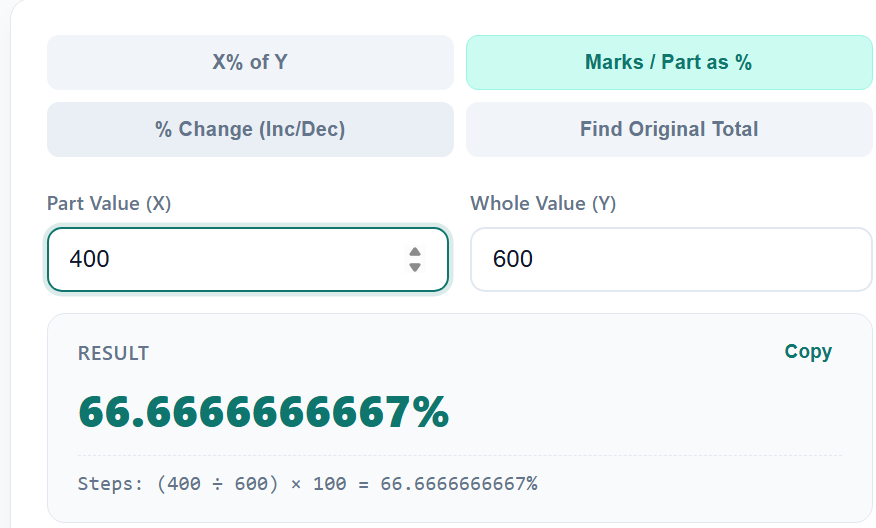
Use this free percentage calculator to find a percentage of a number, compare two values, measure a percentage increase or decrease, or work backward from a known percentage to find the total.
Calculate a percentage
Select a calculation mode and enter two values. The result and formula update as you type.
Percentage formulas and examples
Find a percentage of a number
Divide the percentage by 100 and multiply by the number. For example, 15% of 240 is (15 ÷ 100) × 240 = 36.
Find what percentage one number is of another
Divide the first number by the reference number and multiply by 100. If you scored 42 points out of 50, your percentage is (42 ÷ 50) × 100 = 84%.
Calculate a percentage increase or decrease
Subtract the starting value from the new value, divide by the starting value and multiply by 100. A change from 80 to 100 is a 25% increase. A change from 100 to 80 is a 20% decrease.
Find the original total
Divide the known amount by its percentage and multiply by 100. If 30 is 20% of the total, the total is (30 ÷ 20) × 100 = 150.
Percentage calculator FAQs
Can a percentage be greater than 100%?
Yes. If the amount you compare is larger than its positive reference value, the result exceeds 100%. For example, 150 is 125% of 120.
Can I calculate percentage change from zero?
A zero starting value would require division by zero, so the usual percentage change is undefined. You can still report the absolute difference between the values.
How do I turn marks into a percentage?
Select “Marks / Part as %.” Enter the marks earned in Part Value (X) and the maximum marks in Whole Value (Y). For example, 400 out of 600 is approximately 66.67%. For weighted course grades, use the Grade Calculator.
What does a negative percentage change mean?
When the starting value is positive, a negative result means the new value is lower. For example, −10% represents a 10% decrease.